

Huizhou vs Zhouzhuang Water Towns: Best Heritage Experience for Business Visitors?
When international business professionals visiting China seek a cultural immersion beyond the conference room, two heritage destinations inevitably appear on their radar: the Huizhou ancient villages of southern Anhui (Xidi, Hongcun, and the broader Huangshan region) and the Jiangnan water towns around Suzhou and Shanghai (Zhouzhuang, Tongli, Wuzhen). Both offer quintessentially Chinese historical experiences, but they cater to different business travel contexts, time constraints, and cultural objectives. This guide compares them from the perspective of the visiting executive, corporate travel planner, and business delegations seeking the most rewarding cultural program.
Quick Verdict for Business Visitors: Choose Huizhou villages when you have 2–3 days, want to combine with a Huangshan summit experience, and are hosting VIP clients who appreciate architectural authenticity and UNESCO pedigree. Choose Zhouzhuang-style Jiangnan towns when you need a half-day excursion from Shanghai, are entertaining a larger group, or want the classic “Venice of China” water-town experience with polished tourist infrastructure.
The Jiangnan Water Town Experience: Zhouzhuang as the Benchmark
What Makes Zhouzhuang Iconic
Founded in 1086 during the Northern Song Dynasty, Zhouzhuang is China’s most famous water town, located just 30 kilometers southeast of Suzhou and about 90 minutes from Shanghai. Its defining feature is the intricate network of canals spanned by 14 ancient stone bridges, including the iconic Double Bridge (Shuangqiao), which pairs a stone arch bridge with a stone beam bridge at a right angle. This bridge composition has appeared on the cover of countless China travel guides and in the opening sequences of Chinese period dramas.
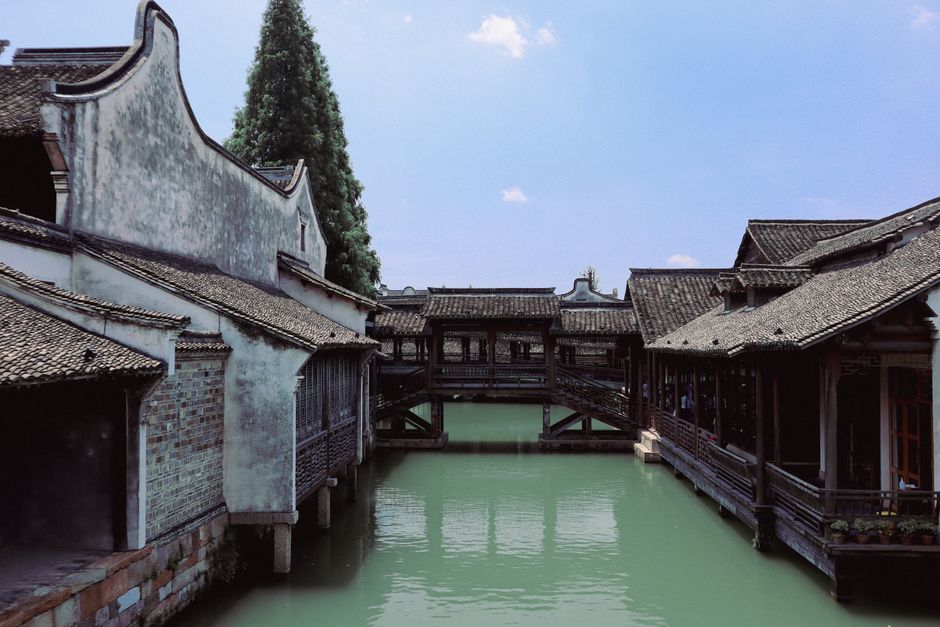
Zhouzhuang’s architecture is representative of the Jiangnan (“south of the Yangtze”) style — dark wood-framed buildings with white-plastered walls and gray-tiled roofs, arranged along narrow pedestrian streets that run parallel to willow-lined canals. The town’s wealth historically came from silk and rice trade, with the Shen family mansion (Shen Ting) being the most opulent residence, covering over 2,000 square meters with more than 100 rooms.
Business Visitor Profile
Zhouzhuang is the default choice for Shanghai-based corporate entertainment. Its proximity to China’s financial capital makes it ideal for half-day or full-day excursions. A typical business itinerary involves morning departure from Shanghai, a canal boat ride (30 minutes, 80–150 RMB per person), lunch at a canal-side restaurant, and return to Shanghai before evening. The town receives approximately 5 million visitors annually, with a substantial proportion being international business travelers.
- Accessibility from Shanghai: 90 minutes by private car, 2 hours by public bus
- English-Language Infrastructure: Excellent — multilingual guides, English menus at major restaurants, international-standard hotels nearby
- Entertainment Value: High — canal boat rides provide immediate visual gratification; the town is compact and walkable in 2–3 hours
- Business Facilities: Good — several hotels with meeting rooms, reliable WiFi, proximity to Suzhou’s substantial business district
- Group Fit: Excellent for delegations of 10–50 people; well-established tour infrastructure exists for every group size
The Huizhou Village Experience: Xidi, Hongcun, and the Huangshan Region
What Makes Huizhou Villages Distinctive
The Huizhou villages of southern Anhui represent a different architectural and cultural tradition from the Jiangnan water towns. While both feature white-walled, dark-tiled buildings, Huizhou architecture is distinguished by its “horse-head” (matouqiang) fire walls — stepped, upward-curving gables that create dramatic silhouettes against the sky. These walls were not decorative but functional, designed to prevent fire spread in closely packed clan compounds. Over centuries, they became the signature aesthetic of the region.
Huizhou villages are nestled at the foot of the Huangshan mountain range, in a landscape of tea terraces, bamboo groves, and mist-shrouded peaks. They are less about canals and more about mountain streams, stone-paved lanes, and the monumental architecture of clan ancestral halls. The water system of Hongcun — an intricate network of household canals engineered in the 12th century — is itself a marvel of pre-modern hydraulic engineering, whereas Zhouzhuang’s canals are natural waterways adapted for transport.
Business Visitor Profile
The Huizhou villages suit business visitors with more time and a deeper cultural interest. They are 3–4 hours from Shanghai by high-speed rail, making them less practical for a same-day round trip but ideal for a 2–3 day program that could include Huangshan itself. International executives with experience in Chinese water towns often find Huizhou villages more memorable precisely because they are less curated and more authentic.
- Accessibility from Shanghai: 3 hours via high-speed rail to Huangshan North Station, then 1 hour by car
- English-Language Infrastructure: Moderate — good signage in major attractions, but guides require advance booking; menus in smaller restaurants are Chinese-only
- Entertainment Value: Very high for culturally sophisticated visitors — but requires more explanation to appreciate fully
- Business Facilities: Adequate — Huangshan city has international-brand hotels with meeting facilities; village guesthouses are charming but lack corporate-standard amenities
- Group Fit: Better for smaller delegations (under 20 people) who can be accommodated in boutique lodging; larger groups require hotels in Huangshan city
Head-to-Head Comparison for Business Travel
| Criteria | Huizhou Villages (Xidi/Hongcun) | Zhouzhuang (Jiangnan Type) |
|---|---|---|
| Distance from Shanghai | ~4 hours door-to-door | ~1.5 hours door-to-door |
| Minimum Time Required | Full day (ideal: 2 days) | Half day (comfortable: full day) |
| UNESCO Status | Yes (2000, with broader region) | Part of “Tongli” buffer zone only |
| Architectural Uniqueness | Horse-head walls, mountain setting | Canals, stone bridges, flat terrain |
| Photography Value | Exceptional (mountain backdrop) | Very good (classic water-town scenes) |
| Crowd Density | Moderate (1–2 million/year) | High (~5 million/year) |
| Corporate Dinner Venues | Limited (3–4 quality options) | Abundant (15+ corporate-ready venues) |
| English Guide Availability | Advance booking required (3–5 days) | Same-day booking possible |
| VIP Program Potential | High (private after-hours access possible for high-value delegations) | Moderate (public space, difficult to privatize) |
Business-Context Analysis: Which Heritage Experience Suits Your Objectives?
Scenario 1: The Shanghai Half-Day Corporate Outing
You have a visiting delegation from Europe or North America with a free afternoon after meetings. They want to “see something Chinese” but have limited energy for travel. Choose Zhouzhuang. The 90-minute drive, canal boat ride (everyone loves it), group lunch, and return by 5:00 PM fits perfectly into a business day. The visual experience is immediately accessible — no cultural primer needed. Zhouzhuang delivers exactly what the term “Chinese water town” evokes in an international visitor’s imagination.
Scenario 2: The VIP Client Immersion Program
Your most important client has expressed genuine interest in Chinese culture. They’ve already visited Shanghai, Beijing, and Xi’an. You want to create a memorable, exclusive experience that demonstrates cultural sophistication. Choose Huizhou. A 2-day program combining Hongcun at sunrise (private early entry can be arranged through high-end hotels), a guided tour explaining Feng Shui principles and clan history, a calligraphy workshop in Xidi, and a closing dinner of Huizhou cuisine at a restored ancestral hall creates a bespoke cultural experience that cannot be replicated in Zhouzhuang.
Scenario 3: The Large Delegation (20+ People)
Your company is hosting a distributor conference or investor summit with multiple nationalities represented. Choose Zhouzhuang. The tourism infrastructure — multiple restaurants seating 100+, standardized ticketing, English-capable guides available in quantity, reliable WiFi throughout, bus parking, accessible restrooms — is designed for volume. Huizhou villages, with their narrow lanes and limited commercial infrastructure, struggle with groups above 15–20. The experience degrades when the group is too large to move through the alleyways comfortably.
Scenario 4: The Combined Business Trip
You are combining business with personal travel, extending a trip for a couple of days of personal exploration. Your spouse or family is joining. Choose Huizhou. The proximity to Huangshan (Yellow Mountains) makes this a vastly richer 3–4 day destination than Zhouzhuang, which has limited additional attractions nearby. The combination of UNESCO villages + mountain hiking + hot springs + Huizhou cuisine creates a complete mini-vacation package that a water town alone cannot match.
Business Travel Tip: For maximum impact, consider a hybrid approach — host your corporate dinner at a restored Huizhou-style venue within Shanghai itself. Venues like the “Wang’s Mansion” in the city’s French Concession area offer Huizhou architecture with Shanghai logistics, combining the best of both worlds.
Cultural Depth: Understanding What You’re Paying For
For the business traveler, there is a direct correlation between cultural context and return on experience. Zhouzhuang offers visual pleasure — the canals, bridges, and boat rides are immediately satisfying without any background knowledge. Huizhou villages offer intellectual pleasure — the Feng Shui logic of village layouts, the clan-based social hierarchy encoded in ancestral hall design, the symbolism in woodcarvings, and the economic history of the Huizhou merchant networks that shaped these villages require explanation to appreciate fully.
If your business guests are genuinely curious about Chinese civilization (as many senior executives traveling to China for the first or second time are), Huizhou provides substantially more substance. The conversation sparked by a guided tour of a Huizhou ancestral hall can lead to discussions about Chinese family structures, regional economics, and cultural continuity — conversations that naturally parallel the relationship-building objectives of business entertainment.
Practical Logistics Comparison
- Zhouzhuang Entry Fee (2024): 100 RMB — includes all major sights within the town
- Hongcun Entry Fee (2024): 104 RMB — includes guided tour map
- Xidi Entry Fee (2024): 94 RMB — includes three ancestral halls
- Zhouzhuang Boat Ride: 80–150 RMB per person, 20–30 minutes, shared or private
- Huizhou Guide Fee: 200–400 RMB for 2-hour English tour (advance booking recommended)
- Corporate Lunch Zhouzhuang: 150–300 RMB per person (10+ dishes, banquet style)
- Corporate Lunch Huizhou: 100–200 RMB per person (local specialties: stinky tofu, bamboo shoots, Anhui ham)
Final Recommendation for Business Visitors
Our Verdict
For foreign business visitors to China, the Huizhou villages offer a culturally richer, more distinctive, and ultimately more memorable experience — but only if you have the time and cultural curiosity to unlock their value. They reward investment: more travel time, more contextual knowledge required, more effort to navigate, but a correspondingly deeper return in cultural insight and lasting impression.
Zhouzhuang and its Jiangnan water town peers are the safer choice for corporate entertainment — lower effort, guaranteed satisfaction, less risk of cultural confusion or logistical frustration. They are the “business lunch” of Chinese heritage tourism: efficient, reliable, and broadly appreciated.
The strategic choice: Use Zhouzhuang for standard corporate entertainment and large group programs. Reserve Huizhou for VIP clients, cultural enthusiasts, and occasions where you want to demonstrate that your company understands China beyond the surface level. The ability to curate the right heritage experience for the right business purpose is itself a sign of cultural competence that sophisticated Chinese partners will notice and respect.