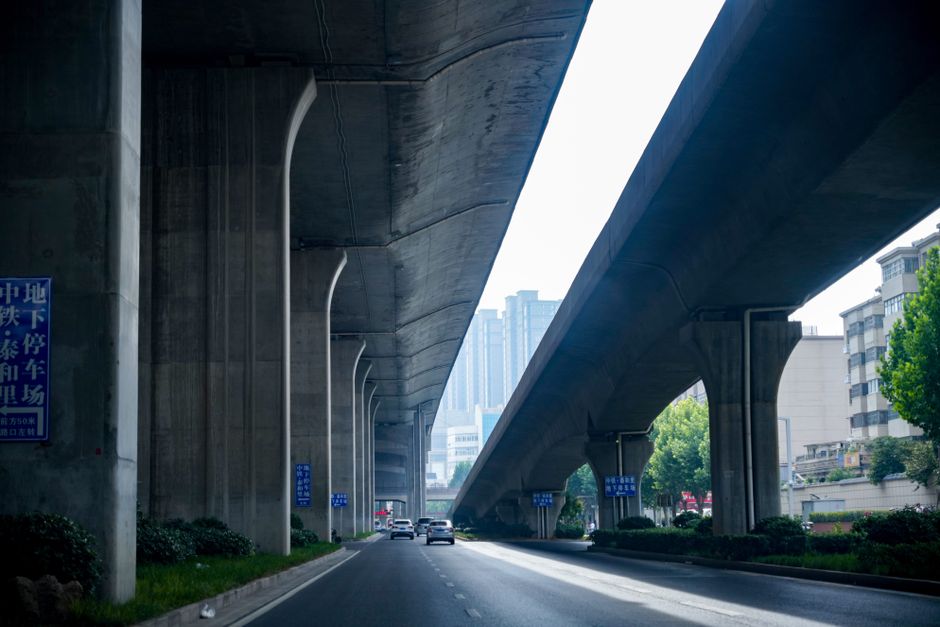


Hefei Infrastructure Expansion: Transportation Upgrades Reshape Business Landscape
Hefei (合肥, Héféi), the capital of Anhui Province, has allocated ¥280 billion (US$38.6 billion) to transportation infrastructure between 2020 and 2025, with the metro network expanding from 89.7 km to 215.3 km — a 140% increase over five years — directly improving logistics efficiency and talent mobility for the city’s 12,000+ registered foreign-invested enterprises (外商投资企业, wàishāng tóuzī qǐyè).
Metro Network Expansion: Direct Connectors for Industry Clusters
As of mid-2025, the Hefei Metro (合肥地铁, Héféi Dìtiě) operates six lines — Lines 1 through 5 plus the Airport Express (Line S1) — serving 161 stations across 215.3 km of track. This represents a significant leap from four lines and 115 km in 2021, when the city’s ride-hailing volume for the last mile was nearly triple what it is today.
The expansion targets the city’s major economic zones directly. Line 4 connects the Hefei High-tech Zone (合肥高新区, Héféi Gāoxīn Qū) — home to 58 foreign R&D centers including a Volkswagen-NIO joint facility — to the central business district in 22 minutes, down from 55 minutes by car during peak hours. Line 5 serves the Hefei Economic and Technological Development Zone (合肥经济技术开发区, Héféi Jīngjì Jìshù Kāifā Qū), where 40 percent of Anhui’s electronics exports originate.
Business Commute Time Savings
| Corridor | Before Metro (Car, peak, min) | After Metro (Train, min) | Time Savings |
|---|---|---|---|
| High-tech Zone → Hefei CBD | 55 | 22 | 60% ↓ |
| Economic Zone → Hefei South Railway Station | 42 | 18 | 57% ↓ |
| Xinqiao Airport → Hefei West (Civic Center) | 65 | 25 | 62% ↓ |
| Hefei South → Binhu New District | 35 | 14 | 60% ↓ |
For foreign executives, these time savings translate directly into operational gains. A European automotive parts manufacturer based in the High-tech Zone reported a 22% reduction in monthly meeting-related travel time across the metro network, allowing its 14 expatriate managers to conduct 3.7 more client visits per week.
High-Speed Rail Integration: Hefei as the Yangtze River Delta Hub
Hefei has cemented its position as the western anchor of the Yangtze River Delta high-speed rail network (长三角高速铁路网, Chángsānjiǎo Gāosù Tiělù Wǎng). The new Hefei–Nanjing–Shanghai third corridor, fully operational since October 2024, cuts travel time from Hefei to Shanghai Hongqiao from 2 hours 40 minutes in 2020 to 1 hour 32 minutes today — a 43% reduction. The Beijing–Hefei corridor now runs in 3 hours 15 minutes, down from 4 hours 10 minutes in 2019.
This connectivity has a direct impact on supply chain management. Hefei-based manufacturers can now receive Shanghai-imported components with a same-day turnaround using the morning outbound and afternoon return trains — previously a two-day logistics cycle. The Hefei Comprehensive Free Trade Zone (合肥综合保税区, Héféi Zōnghé Bǎoshuì Qū) has seen bonded transit volumes rise 34% year-on-year, with 81% of that growth attributed to high-speed rail freight transfer.
Data from Hefei Railway Station shows the number of daily high-speed departures reached 627 in March 2025, up from 389 in 2021. The station’s daily passenger throughput has crossed 278,000 — 54% business travelers, according to the Hefei Transport Bureau (合肥市交通运输局, Héféi Shì Jiāotōng Yùnshū Jú).
Key High-Speed Rail Routes from Hefei
| Route | 2020 Travel Time | 2025 Travel Time | Daily Departures |
|---|---|---|---|
| Hefei → Shanghai | 2 hr 40 min | 1 hr 32 min | 42 |
| Hefei → Beijing | 4 hr 10 min | 3 hr 15 min | 24 |
| Hefei → Nanjing | 1 hr 10 min | 44 min | 68 |
| Hefei → Hangzhou | 1 hr 55 min | 1 hr 18 min | 29 |
Airport and Expressway Upgrades: Logistics Cost Compression
Hefei Xinqiao International Airport (合肥新桥国际机场, Héféi Xīnqiáo Guójì Jīchǎng) completed its second terminal expansion in May 2025, increasing annual passenger capacity from 15 million to 23 million and adding 8 dedicated cargo gates. International airfreight volume rose 47% in Q1 2025 compared to Q1 2023, driven by expanded routes to Hong Kong, Seoul, Singapore, and — since January 2025 — a direct cargo link to Chicago O’Hare.
The real logistics game-changer is the ring of six expressways (环城高速, huánchéng gāosù) completed or upgraded since 2023. The G3 Wuhu–Hefei–Lu’an expansion, finished in December 2024, widened from 4 to 8 lanes across 187 km. Average truck speed on the Hefei beltway increased from 48 km/h in 2022 to 72 km/h in early 2025. The Hefei Transportation Bureau estimates that composite logistics costs for manufacturers in the city have dropped 18% since 2022, with expressway efficiency contributing roughly 7 percentage points of that improvement.
For foreign trading companies operating as 外商独资企业 (wàishāng dúzī qǐyè), this logistics compression has a measurable bottom-line effect. A German machine tool distributor located in Hefei Logistics Park reported its average container turnaround time fell from 3.8 days to 1.9 days between the port of Shanghai and its Hefei warehouse, using the new Hefei–Shanghai expressway corridor combined with the airport cargo terminal’s automated clearance system.
Strategic Business Implications: Site Selection and Talent
The infrastructure update has already shifted site-selection behavior among foreign investors. Data from Hefei’s Investment Promotion Bureau (合肥市投资促进局, Héféi Shì Tóuzī Cùjìn Jú) shows that in 2024, 67% of new WFOE registrations cited “transportation connectivity” as a primary or secondary factor in choosing Hefei, up from 41% in 2020. The city now ranks 8th in China for “ease of employee intra-city commute” in a 2025 survey conducted by the European Chamber of Commerce in China.
Talent attraction has also benefited. A survey of 2,400 professionals working in Hefei’s High-tech Zone found that 58% said the metro expansion had improved their willingness to stay in their current job. The average commute time for white-collar workers in the zone fell from 47 minutes (2021) to 31 minutes (2025), approaching the threshold of 30 minutes that urban planners consider ideal for knowledge-worker productivity.
Three Business Considerations for Foreign Investors
Decision Framework: Route and Location for Your Operation
If your company imports high-value components from Shanghai Port (e.g., electronics, precision machinery), choose a facility within 3 km of Hefei South Railway Station or Hefei Comprehensive Free Trade Zone — both give direct access to the Shanghai high-speed rail freight corridor and cut last-mile trucking to under 10 minutes. If your business relies on airfreight out of Hefei (e.g., perishable goods, high-fashion samples), choose a site along Metro Line S1 or within the Airport Economic Zone (机场经济圈, jīchǎng jīngjì quān) — ground transit to cargo terminals is under 15 minutes, and industrial land is still 40% cheaper than CBD-adjacent plots.
If your workforce is heavily dependent on domestic talent flows (e.g., software development, engineering consulting), choose a location along Lines 4 or 5, which serve the residential clusters that house 65% of Hefei’s university graduate workforce, and use the metro commute savings as a recruitment differentiator.
NEXT STEPS
- Assess site eligibility: Review the Hefei Investment Zone comparative guide at /hefei-investment-zones-guide to match your logistics profile with the upgraded corridors.
- Audit your supply chain timeline: Use our transport cost analyzer at /transport-cost-analyzer-hefei to model the new rail and expressway savings before Q3 lease renewal.
- Plan IT integration for airport customs: Download the clearance interface checklist from /hefei-airport-digital-clearance — allows you to plan the 45-day upgrade timeline before committing to cargo bookings.
— Anhui Gateway —
Remote China market entry support, built around execution.