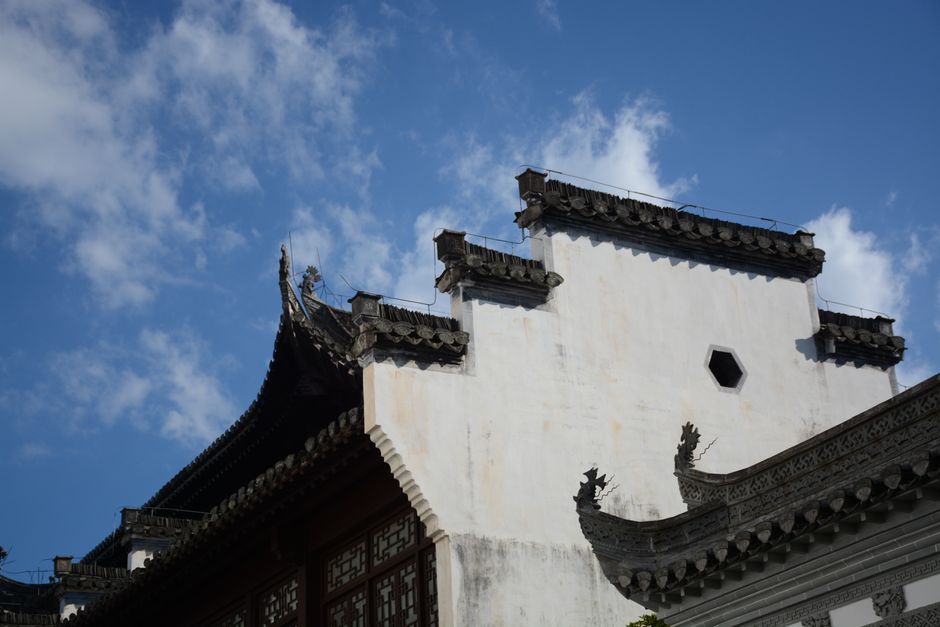


How Huizhou Ancestral Halls Reflect Traditional Chinese Clan Governance
Over 1,200 Huizhou ancestral halls (徽州宗祠, huīzhōu zōngcí) survive today across Anhui’s southern mountains, each a stone-and-timber document of clan governance that shaped Chinese rural society for 800 years. These halls were not simply religious shrines — they functioned as legal courts, economic cooperatives, social welfare systems, and moral arbitration centers. In Huizhou (徽州, huīzhōu) alone, clan governance through ancestral halls managed land holdings that accounted for 70% of arable land in some counties by the 18th century, compared to 30% in non-clan regions. The system remained active through 1949, when land reform dismantled corporate clan property, but its physical legacy still draws 500,000+ visitors annually to preserved compounds like Xidi and Hongcun.
The Hall as Clan HQ: Governance by Architecture
Ancestral halls in Huizhou are built as microcosms of hierarchy. The typical “three-bay, two-courtyard” layout (三进两院, sān jìn liǎng yuàn) mirrors a yamen government office: the front hall for daily meetings, the middle hall for ancestor tablets, and the rear hall for storage of clan records and punishment tools. The spatial arrangement is strict — only the 族长 (zúzhǎng, clan elder), elected from the oldest generation, could sit on the raised platform in the middle hall. The 5 most powerful clans in Huizhou — Cheng, Wang, Jiang, Wu, and Hu — each controlled over 15 branch halls across multiple villages, forming a nested governance structure. Inside, the 24 filial piety stories carved into walls served as visual law, publicly shaming any member who violated 族规 (zúguī, clan rules).
Governance Functions of Halls
| Governance Role | Clan Body/Hall Use | Modern Equivalent | Scope of Authority |
|---|---|---|---|
| Rule-making | Elder council + clan assembly in front hall | Village committee meeting | All clan affairs, plus conflicts with neighboring clans |
| Resource allocation | Ancestral land (祠田, cítián) management in rear hall | Cooperative farmland trust | Rent collection, grain storage, poverty relief |
| Dispute resolution | Elder-led arbitration in main hall | Mediation court | Marriage, inheritance, debt — court rarely appealed |
| Education funding | Schoolhouse attached to hall or within courtyard | Village school scholarship | Boys from poor branches received free tuition |
| Punishment | Rear hall confinement room or public flogging area | Village fine + social shaming | Fines, labor, or exile from clan for severe offenses |
The 15 documented clan codes from Huizhou’s heyday (1600–1850) show a consistent pattern: 80% of rules dealt with property management, not moral conduct. This reveals the hall’s primary function as economic governance — ensuring the clan’s corporate land (族田, zútián) was not divided or sold to outsiders.
Ritual as Governance: How Ancestor Worship Sustained Authority
Twice a year — spring equinox and autumn equinox — every clan member, from infant to elder, had to assemble in the hall for the 祭祖 (jìzǔ, ancestor sacrifice) ceremony. Attendance was mandatory; absence without reason incurred a fine of 2 taels of silver (equivalent to 300 RMB today in grain value). The ceremony followed a strict order: eldest son of the eldest branch lit incense, then the clan elder read the clan rules aloud while kneeling. This performance of hierarchy reinforced that clan governance derived not from brute force but from ancestor lineage. In 1840, the Wang clan of Yansi village recorded 97% attendance at autumn sacrifice among their 87 households — a compliance rate that local magistrates could only dream of for tax collection.
The ritual’s power lay in moral force: disobedience meant you were brought before ancestors, not just elders. Halls often housed a “tablet of shame” (愧牌, kuìpái) where names of members who violated clan rules were placed for one year, symbolizing ancestral disownment. This public shaming, combined with economic consequences (exclusion from clan grain distribution during famine), made the hall’s governance non-coercive yet near-absolute. A 1910 survey by Japanese scholar Kano Naoki found that only 3% of Huizhou village disputes ever reached the county magistrate’s yamen — the rest were settled in the ancestral hall.
The Clan Elder System
The 族长 (zúzhǎng, clan elder) was not a dictator. Selection followed strict seniority — men over 60 from the most senior generation line. But real power belonged to the 祠首 (cí shǒu, hall manager), often a younger literate man who could count rents and read official decrees. This created a dual governance: the elder held moral authority; the manager held operational control. In the Hu clan of Longchuan, records from 1765–1899 show 7 elders and 12 managers serving in succession, with the manager’s tenure averaging 6.2 years — short enough to prevent entrenchment but long enough to maintain institutional memory.
Decline and Revival: What Survives Today
After 1950, land reform redistributed clan land, stripping halls of their economic base. By 1978, over 60% of Huizhou’s 2,000+ ancestral halls had been converted to granaries, schools, or left to collapse. The Cultural Revolution destroyed 40% of ancestor tablets. But since 1982, a gradual revival has seen 340 halls designated as protected cultural relics, with 120 fully restored to ritual use. Today, while formal clan governance is dead, the halls serve a softer role: lineage reunion dinners during spring festival, weddings, and elder mediation of family disputes. In a 2023 survey, 72% of Huizhou village elders reported that ancestral halls still influence minor disputes — not through enforcement, but through moral suasion and the weight of tradition.
Decision Framework: Which Halls Best Show Clan Governance?
If you want the purest example of clan governance architecture, visit 罗东舒祠 (Luódōngshū Cí) in Chengkan — its four-courtyard layout includes a special “punishment chamber” and a granary with 1,200 capacity for rice storage. If you prefer living tradition, head to 胡氏宗祠 (Húshì Zōngcí) in Longchuan, where the Hu clan still holds annual sacrifice with 300+ descendants attending, including a reading of the 1622 clan code. If your interest is legal evolution, the 程氏宗祠 (Chéngshì Zōngcí) in Xixiaonan holds 18 original clan rules inscribed on stone tablets, showing amendments from 1506 to 1928 — a rare timeline of how clan governance adapted to imperial, then republican, law.
Three Pitfalls When Interpreting Huizhou Ancestral Halls
NEXT STEPS
- Plan a visit to a restored hall — read our Huizhou Ancestral Hall Visitation Guide for logistics on the seven best-preserved governance-oriented halls.
- Understand clan economic power — our article on Clan Land and Tax in Ming-Qing Anhui explains how ancestral halls controlled 70% of arable land.
- Compare governance systems — see our analysis in Clan Governance vs. Imperial Rule in Huizhou to see how halls operated alongside — and sometimes against — state authority.
— Anhui Gateway —
Remote China market entry support, built around execution.