

Xidi vs Hongcun: Which Huizhou Village Should Foreign Visitors Prioritize?
For any foreign traveler planning a trip to China’s Anhui Province, the question inevitably arises: Xidi or Hongcun? These two UNESCO World Heritage villages, nestled at the foot of the Yellow Mountains (Huangshan), represent the pinnacle of Huizhou architectural heritage. Yet they offer profoundly different experiences. This comprehensive comparison helps international visitors decide which village deserves their limited travel time — or why visiting both might be the best choice.
Quick Verdict: Choose Hongcun for its cinematic water-town atmosphere, iconic moon pond, and easier logistics. Choose Xidi for a quieter, more scholarly experience with a more authentic sense of living history. Ideally, visit both — they are only 30 minutes apart.
UNESCO World Heritage Status: The Shared Pedigree
Both Xidi and Hongcun were inscribed as UNESCO World Heritage Sites in 2000 under the title “Ancient Villages in Southern Anhui.” UNESCO’s citation describes them as “exceptional examples of the rural settlements of the Ming and Qing dynasties that flourished in the Huizhou region from the 14th to the 20th centuries.” Together, they preserve over 350 ancient residences, ancestral halls, and memorial archways spanning 600 years of continuous habitation.
But UNESCO recognition alone doesn’t tell a foreign visitor which village to prioritize. The differences run deep — in layout, atmosphere, photographic opportunities, cultural density, and practical accessibility.
Hongcun: The “Village in the Painting”
Layout and Water System
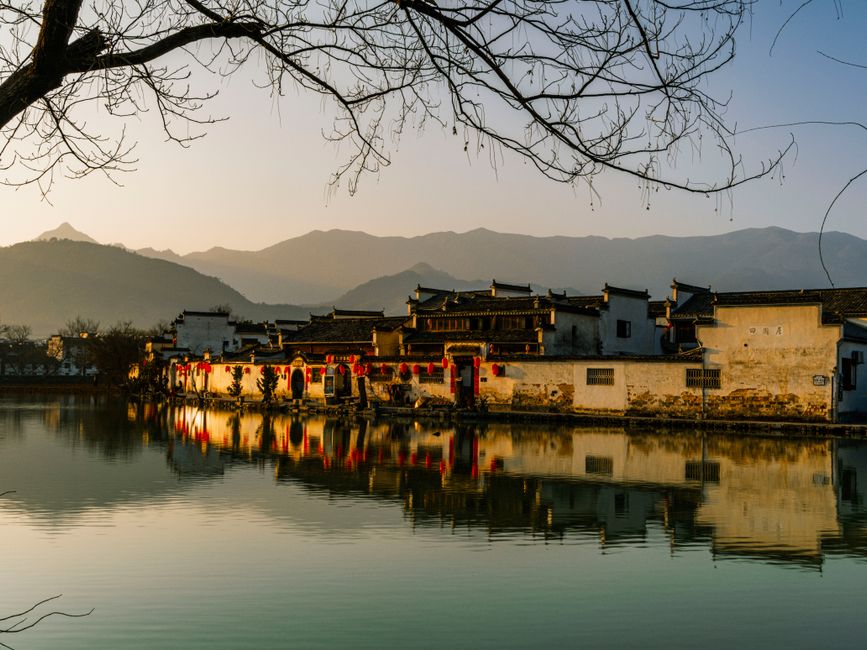
Hongcun’s most distinctive feature is its ingenious water management system. Built in 1131 during the Southern Song Dynasty, the village was designed to resemble an ox — the hill (Leigang) is the head, the two ancient trees at the entrance are the horns, the residential clusters form the body, and the intricate network of canals flowing through every household represents the ox’s digestive system. The centerpiece is the crescent-shaped Moon Pond (Yuezhao), arguably the most photographed spot in all of Anhui.
Water flows through a 600-meter main canal that branches into hundreds of smaller channels, providing each home with fresh water for drinking, washing, and fire prevention. This system, still functioning today, was conceived over 800 years ago by Feng Shui masters and remains one of the most sophisticated pre-modern water supply networks in rural China.
Cinematic Fame
Hongcun gained international recognition as a filming location for Ang Lee’s Oscar-winning film “Crouching Tiger, Hidden Dragon” (2000). The famous scene where Chow Yun-Fat and Zhang Ziyi glide across a pond was shot at the Moon Pond. This cinematic connection draws film enthusiasts and photographers who recognize the village’s ethereal beauty from the silver screen. The tourism infrastructure has developed accordingly — English signage, guided tour options, and bilingual materials are more prevalent here than in Xidi.
What Foreign Visitors Will Experience
- Iconic Photography: The Moon Pond reflection of white-walled, black-tiled architecture is unmatched anywhere in China. Sunrise and late afternoon offer the best light.
- Crowds: Hongcun is the more popular destination. Expect significant crowds, especially during Chinese holidays (May Day, National Day, Spring Festival). Morning visits before 9:00 AM are strongly recommended.
- Museums and Exhibitions: Several former merchant homes now function as museums displaying Huizhou furniture, calligraphy, and domestic artifacts. The Chengzhi Hall is the most elaborate, featuring exquisite woodcarvings that tell stories from Chinese opera and mythology.
- Accommodation: Hongcun has more boutique guesthouses within the village walls, many converted from historic residences, offering an immersive overnight experience.
- Accessibility: The main pathways are relatively flat and easy to navigate. The village entrance is well-marked with multilingual information.
Xidi: The Quiet Scholar’s Retreat
Layout and Architecture
Xidi, founded in 1047 during the Northern Song Dynasty, was built by the Hu clan — descendants of Hu Changyi, a crown prince of the Tang Dynasty. Unlike Hongcun’s water-centric layout, Xidi is organized along a broad main street with 124 preserved residences, 3 ancestral halls, and 1 memorial archway complex. The village’s most striking feature is the Hu Wenguang Memorial Archway, a four-pillar, five-story stone archway erected in 1578 that greets visitors at the eastern entrance.
Xidi’s layout reflects a more deliberate urban planning tradition. The village is divided into three main streets and dozens of lanes, with every turn revealing carefully composed architectural vignettes. The buildings here tend to be more elaborate in their woodcarving detail, with some residences featuring three-story structures that are rare in Hongcun.
The “Living Museum” Quality
What distinguishes Xidi from Hongcun is its sense of authentic daily life. While Hongcun has become heavily commercialized with souvenir shops every few meters, Xidi retains more residents who go about their daily routines — elderly women washing vegetables at communal taps, children playing in narrow lanes, and artisans carving inkstones in open-fronted workshops. This living quality gives Xidi a less curated, more genuine atmosphere that many culturally-minded foreign visitors prefer.
What Foreign Visitors Will Experience
- Architectural Purity: Xidi’s residences are generally considered more architecturally significant. The “Hall of Respect” (Jing’ai Tang) and the “Hall of Happiness” (Le Shan Tang) feature some of the finest Huizhou woodcarving in existence.
- Fewer Crowds: Xidi receives roughly 40% fewer visitors than Hongcun. This means quieter lanes, more opportunities for undisturbed photography, and a more contemplative experience.
- Ancestral Halls: Xidi has three major ancestral halls that trace the Hu clan’s lineage over nearly 1,000 years. These halls provide profound insight into the clan-based social structure that defined Huizhou culture.
- Less Commercialization: While shops exist, they are less pervasive and more likely to sell locally made products (tea, ink, bamboo crafts) rather than generic tourist souvenirs.
- Night Atmosphere: Xidi’s lighting is more subdued after dark, creating a genuinely atmospheric evening experience. This is when the village most feels like stepping back in time.
Head-to-Head Comparison Table
| Feature | Hongcun | Xidi |
|---|---|---|
| UNESCO Inscription | 2000 (with Xidi) | 2000 (with Hongcun) |
| Founded | 1131 (Southern Song) | 1047 (Northern Song) |
| Preserved Residences | ~140 | ~124 |
| Water System | Extensive canal network, Moon Pond | Limited streams, no central pond |
| Film Location | Crouching Tiger, Hidden Dragon | Ju Dou (Zhang Yimou, 1990) |
| Annual Visitors | ~2 million | ~1.2 million |
| Entry Fee (2024) | ~104 RMB | ~94 RMB |
| English Signage | Excellent | Good but less comprehensive |
| Best For | Photographers, first-timers | Architecture enthusiasts, culture seekers |
| Time Needed | 3–4 hours | 2–3 hours |
Practical Considerations for Foreign Visitors
Getting There
Both villages are accessible from Huangshan North Station (high-speed rail from Shanghai, Hangzhou, or Beijing). From the station, take Bus Route 1 to the Tangkou bus station, then transfer to a direct bus to either village. A more convenient option is hiring a private driver for approximately 200–300 RMB (US$28–42) for a half-day visit covering both villages. Budget-conscious travelers can stay in the town of Yixian, which has affordable accommodation and frequent buses to both villages.
Best Time to Visit
March–April: Rape flower fields bloom around both villages, creating stunning yellow carpets against white-walled architecture. This is peak photography season but also crowded.
October–November: Autumn colors frame the villages beautifully. Weather is mild and skies are often clear. This is arguably the optimal window for foreign visitors.
December–February: Winter offers the quietest experience. Snow on black-tiled roofs creates magical scenes, but some guesthouses close and temperatures drop near freezing.
June–August: Hot and humid with summer rain. The water channels in Hongcun provide some cooling effect, but crowds are heavy. Visit early morning to avoid both heat and queues.
Suggested Itineraries
If You Have Only 3–4 Hours: Choose Hongcun. You can experience the Moon Pond, walk the main canal routes, visit Chengzhi Hall, and absorb the water-town atmosphere within a half-day trip from Huangshan.
If You Have a Full Day: Visit both. Start at Hongcun at 7:30 AM to beat the crowds, spend until 10:30 AM, then drive 30 minutes to Xidi. Have lunch at a local restaurant in Xidi (try the stinky tofu and bamboo shoots), then explore Xidi’s quieter lanes until mid-afternoon.
If You Have Two Days: Stay overnight in Xidi. The evening and early morning when tour groups are absent transform the experience. Spend the second morning in Hongcun before heading to Huangshan.
Cultural Context: Understanding Huizhou Architecture
Both villages exemplify the hallmarks of Huizhou architectural style: whitewashed walls with black brick trim, gracefully curved eaves, elaborate woodcarving on beams and columns, and the distinctive “horse-head” (matouqiang) fire walls that rise in stepped tiers above the rooflines. These fire walls, originally designed to prevent the spread of fires in densely packed villages, have become the defining visual signature of Huizhou architecture.
The layout of both villages was guided by Feng Shui principles — Hongcun’s ox-shaped design being the most elaborate example. Ancestral halls face south, homes are arranged along waterways, and key structures align with mountain peaks considered auspicious. Understanding this spatial philosophy enriches any visit, transforming what might seem like random lanes into a deliberate, meaningful settlement pattern.
The Foreign Visitor’s Experience: Language and Logistics
English proficiency in both villages is limited to ticket office staff and better hotels. Download Pleco or Google Translate for basic communication. Major attractions within the villages have English descriptions, but the detailed cultural significance behind carvings, calligraphy, and architectural features is often only in Chinese. Consider hiring an English-speaking guide through your hotel — typically 200–300 RMB for a 2-hour tour.
Final Verdict
Our Recommendation for Foreign Visitors
Prioritize Hongcun if: This is your first visit to a Huizhou village, you’re a photographer looking for iconic shots, you have limited time and want the most visually dramatic experience, or you’re traveling with family and appreciate better tourist infrastructure.
Prioritize Xidi if: You have a serious interest in Chinese architecture, you prefer quieter, less commercialized historical sites, you want to see genuine village life rather than a curated tourist product, or you’ve already visited Chinese water towns and want a more scholarly experience.
Visit both if possible. They are complementary, not competitive. Hongcun delivers the visual spectacle and cinematic romance; Xidi offers architectural depth and authentic atmosphere. Together, they provide the complete Huizhou experience — the painting and the reality, the postcard and the story behind it. For foreign professionals, academics, or business visitors with cultural interests, the combined visit offers unparalleled insight into one of China’s most distinctive regional cultures, a legacy that continues to influence contemporary Chinese aesthetics from architecture to interior design.