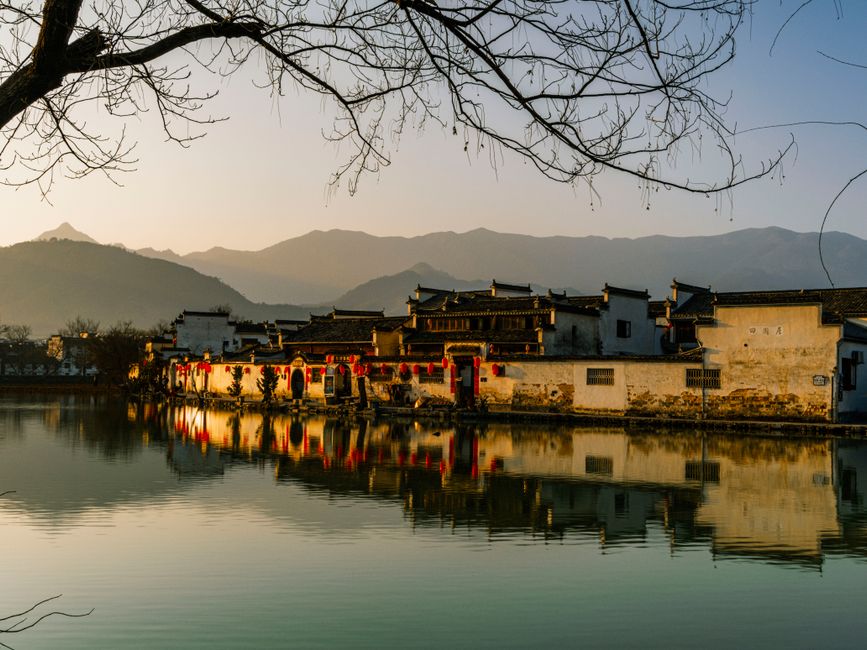


Xidi vs Hongcun: Which Huizhou Village Should Foreign Visitors Prioritize?
Of the nearly 7,000 villages in China’s Anhui province, only two — Xidi (西递, Xīdì, West Post) and Hongcun (宏村, Hóngcūn, Grand Village) — hold UNESCO World Heritage status as “Ancient Villages in Southern Anhui,” a title they earned in 2000. Together, they draw 3+ million annual visitors, yet each offers a fundamentally different experience. This guide compares them across 9 decision criteria so foreign executives and travelers can allocate their limited time (average stay: 2–3 hours per site) with confidence.
Both villages are located in Huizhou (徽州, Huīzhōu) region, Yi County, roughly 50 km from Huangshan city. They share the iconic “horsehead walls” (马头墙, mǎtóu qiáng, horsehead wall) and elaborate Huizhou merchant architecture, but diverge sharply in layout, crowd density, clan heritage, and cinematic fame. Hongcun receives 2+ million annual visitors vs ~800,000 for Xidi — a 2.5x difference that shapes everything from photo opportunities to ticket prices.
Historical Background and Architectural Significance
Xidi: The Merchant Clan’s Testament
Founded in 1047 during the Northern Song dynasty, Xidi grew wealthy from Huizhou merchants trading tea, timber, and silk throughout the Yangtze River Delta. At its peak, the Hu (胡) clan controlled 124 ancestral halls and residential compounds within the village. Approximately 90% of Xidi’s existing structures date from the Ming (1368–1644) and Qing (1644–1912) dynasties, making it one of the best-preserved merchant villages in China. The lineage system (宗法制度, zōngfǎ zhìdù, patriarchal clan system) dictated every detail: courtyard symmetry, rank-based room sizes, and even the height of doorsteps — a visual hierarchy visible today in the village’s grid-like street pattern.
Hongcun: The Water System Masterpiece
Hongcun was first settled in 1131 by the Wang (汪) clan, who engineered an elaborate water supply network still in use. Over 1,400 meters of stone-lined canals channel water from a mountain stream through every household, collecting in Moon Pond (月沼, Yuèzhǎo) and South Lake (南湖, Nánhú). This hydrologic system, designed by Feng Shui master He Keda in the 14th century, cools the village in summer and flushes waste — a practical innovation that UNESCO cited as “an outstanding example of traditional human settlement.” Hongcun has ~140 standing structures, about 20 more than Xidi, including the famous Chengzhi Hall (承志堂, Chéngzhì Táng, Hall of Aspiration), a merchant’s mansion covering 2,800 square meters with 126 carved columns.
Layout, Navigation, and Visitor Experience
Xidi follows a symmetric grid pattern: two main streets intersect with seven lanes, all leading to a central ancestral hall. Walking times: Main circuit 1.5–2 hours; detailed exploration 4 hours. Hongcun is more organic, winding along its canals — visitors naturally follow the water through a 2–3 hour loop. The difference matters: Xidi feels like a museum with clear sightlines; Hongcun encourages aimless wandering but disorients first-timers.
| Comparison Factor | Xidi (西递) | Hongcun (宏村) |
|---|---|---|
| UNESCO Inscription Year | 2000 | 2000 |
| Primary Clan | Hu (胡) | Wang (汪) |
| Year Founded | 1047 | 1131 |
| Existing Structures (Ming/Qing) | ~124 | ~140 |
| Annual Visitors (2023) | ~800,000 | ~2,000,000 |
| Entry Fee (Foreigner Rate) | 104 RMB | 104 RMB |
| Average Visit Duration | 3 hours | 2.5 hours |
| Peak Hours Crowd Factor | Low (5–15 people/site) | High (50–150 people/site) |
| Photography Ease (Scale 1–5) | 5 (open sightlines) | 2 (narrow lanes, crowds) |
| Movie Recognitions | None major | Crouching Tiger, Hidden Dragon (2000); China tourism campaigns |
Hongcun’s 2x annual visitor count creates significant crowding during peak months (April–May, October). Xidi’s lower traffic means 90% fewer people per frame during golden hour photography sessions. Both villages enforce strict no-selfie-stick rules at key halls to protect wood carvings — fines start at 200 RMB for violators.
Cultural Identity and Clan Systems
Xidi preserves the Hu clan ancestral hall (敬爱堂, Jìng’ài Táng, Respect and Love Hall) containing 765 genealogical records spanning 1,100 years. Foreign visitors interested in Chinese lineage systems should prioritize Xidi — the clan still holds annual Qingming Festival rituals (清明祭祖, Qīngmíng jìzǔ) each April, drawing 3,000+ descendants. Hongcun’s Wang clan records are less complete (only 600 years), and the village focuses more on water-management heritage. For executives evaluating China’s social structures: Xidi is the best case study of how merchant clans used architecture to project status and maintain hierarchy.
Decision Framework: Which Village Should You Visit?
Based on your goals, here is a structured choice matrix:
- If you are a first-time China visitor with ≤ 3 hours for one village: choose Hongcun. Its water canals, Moon Pond reflection shots, and Crouching Tiger recognition provide instant visual payoff. Hongcun appears in 40+ travel magazines annually (vs. 12 for Xidi).
- If you are a veteran traveler or history researcher seeking less crowded, intellectually rich experience: choose Xidi. You will understand clan governance, see 90% less foot traffic, and photograph Ming-era woodcarving without tourists in frame.
- If you have 5–6 hours total (e.g., half-day trip from Huangshan): visit both. Start at Xidi for the historical context (8:00–11:00), then drive 30 minutes to Hongcun for lunch and the water system (11:30–14:30). The combined 208 RMB entry is 35% cheaper than two separate tickets if you buy a combo pass.
Three Common Pitfalls (and How to Avoid Them)
Cost: You waste 2 hours in queues at Chengzhi Hall during peak (11:00–14:00). Average queue wait: 45 minutes on a Saturday in May.
Fix: Arrive at Hongcun by 7:30 (opening time) or after 15:30. Alternatively, swap to Xidi for midday visits — wait times are under 5 minutes all day.
Cost: You miss 70% of the clan story — without context, ancestral halls look like empty rooms. Standard guide fees: 150 RMB per hour.
Fix: Book a certified guide (available at ticket booth) for the 2-hour tour. Many speak basic English; ask for “English audio headset” (英文耳机, Yīngwén ěrjī) if language is a barrier.
Cost: Hongcun’s visitor count spikes to 15,000+ per day vs normal 5,500. Moon Pond becomes unphotographable. Xidi reaches 8,000 — still 3x normal.
Fix: Check the Chinese holiday calendar (export from Anhui Gateway’s travel planner). If you must travel during holidays, Xidi is the better choice: its wider streets handle crowds better.
Verdict: Prioritize Based on Purpose
For foreign executives or investors evaluating cultural assets: Xidi offers deeper insight into Huizhou merchant society, with unspoiled Ming architecture and a calm atmosphere that facilitates business conversations. Hongcun is the better choice for marketing imagery, social media content, or client entertainment — its water reflections are China’s most photographed village scene. Neither disappoints, but the tradeoff between solitude and spectacle is real: you trade 2.5x crowds (Hongcun) for 20% fewer structures (Xidi). Plan your half-day around your most important outcome.
NEXT STEPS
- Download a 1-day Huizhou village itinerary including driving times and restaurant recommendations. Review our Huizhou Village Day Trip Guide.
- Check the Huangshan weather and holiday calendar before booking. Use our Huangshan Travel Timing Tool for crowd avoidance.
- Prepare your entry documents. Foreign visitors need a valid visa and sometimes a registration form at Yi County Tourism Office. Read the Anhui Village Entry Requirements article.
— Anhui Gateway —
Remote China market entry support, built around execution.